Friday, 16 April 2010

Tetovo (Тетово)

Back across the border after a long drive (who said it would only take two hours?!), Tetovo (map) is the largest city in the north-west, about an hour from Skopje. Two sites were particularly special here, the Painted Mosque, and the Bektashi Baba Arabati Tekke.

As the name would suggest, the Painted Mosque is, well, painted. Everywhere. Though built in the 15th century, but its most spectacular frescoes date from the 1833 reconstruction by Abdurahman Pasha, when it was covered with floral and geometrical motifs.


the Painted Mosque

We were fortunate to arrive at the Tekke just as evening prayers were finishing, and so were taken under the wing of a kind seventy-four year old. He shewed us around, and insisted we stay for coffee. Again, as at the Patriarchate, an excellent end to the day...


The Baba Arabati Tekke

Prizren

Prizren (map) nestles under the mountains that form the border with Albania, and is overlooked by an old castle that controlled the plain, and now offers a fine view of the city: walking up at sunset is by far the best way to appreciate Prizren, with its river winding through the middle of the old town and under the requisite Ottoman bridge.


Sunset in Prizren


The view from the Castle


The Ottoman Bridge

The peace up there contrasts strongly with the bustling centre, with shops crowded either side of th streets round the sad remains of churches still out of action (and out of bounds) after the unrest in 2004. There were also signs threatening the strictest measure against anyone committing criminal acts against them, but, once again, restoration work is well underway, and, when there were guards, they did not seem to expect too much bother. Now that the Orthodox Cathedral has been restored, the fine architectural trio of Catholic Cathedral, Orthodox Cathedral, and Sinan Pasha Mosque is also once again complete.


No caption required


Catholic Cathedral

Dečani and Velika Hoča

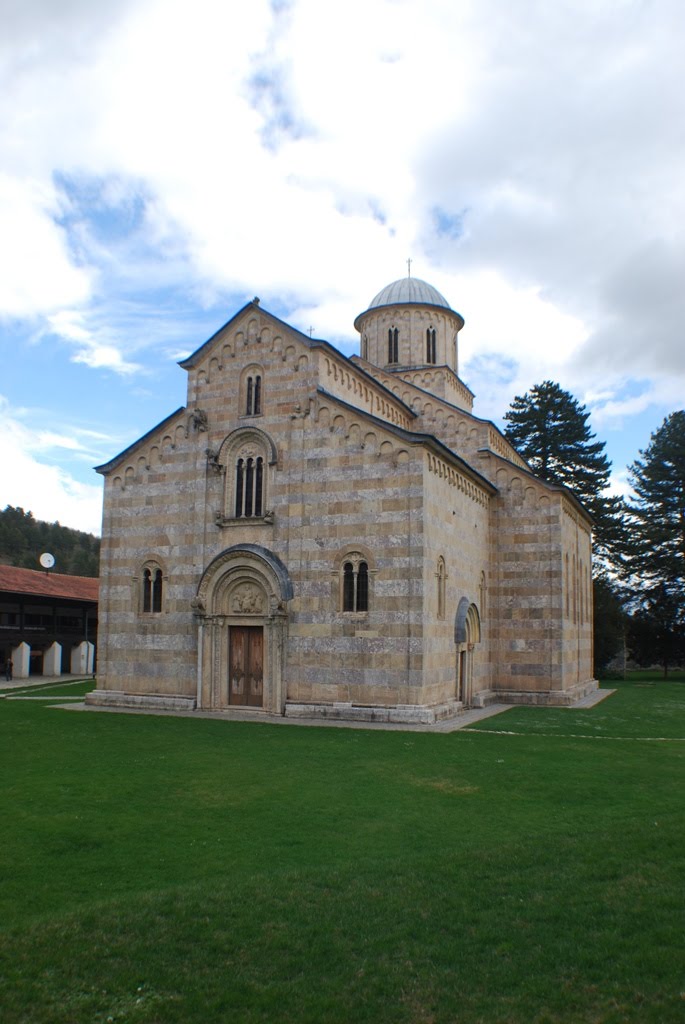
We stopped en route to Prizren at Dečani monastery (map), another important Serbian Orthodox monastery, which was built between 1327 and 1335 by the Serbian king St. Stephen. Again, no photographing inside, but the frescoes are worth a visit.


Dečani

The monk on duty in the gift shop was also very affable, and recommended a visit to a ninth-century church in Velika Hoča (map), a small village slightly off the route to Prizren, - though he spoke of the villagers as being hostages in their enclave, under continuous guard from KFOR, and so was not sure how easy it would be.


St John's, Velika Hoča

Nevertheless, off we went, to what was perhaps the most moving part of our time in Kosovo. Until then, Kosovo had seemed vaguely... 'normal', - or, at least, more 'westernised' than is the norm in this region. To begin with, all was fine: we decided to get a taxi rather than wait an hour for the first of several busses we should have had to take, and found one without any difficulty, the (Albanian) driver not blinking when we said where we wanted to go. When we stopped for directions, however, it became clear he had thought we were heading for a larger Albanian settlement nearby, not serbski Hoča, and he became quite... panic-stricken? He tried to dissuade us, speaking of the long distance we would have to walk after the KFOR blockade into the town, and explaining that he could not enter the village. We obviously did not insist that he go, and the (Albanian) local who was giving us directions offered to take us instead, - which he did, without any hesitation or difficulty, chatting affably with the locals when we arrived. Perhaps the presence of mad clear foreigners created a bond, - and any outside impression can only be partial and/or naive, - but it did seem as though there was at least a certain understanding on the local level, - particularly among the younger members of the community. Which is reassuring to this woolly, wet liberal, though I can still picture the face of the taxi driver, and it was sad (though not surprising) to encounter a continued broader distrust.


War Memorial

The village itself? The church was wonderful (no photographing again), but it was depressingly empty. Whether it was more dead as a community than other local small villages, though, or even small communities in Britain or America, is difficult to gauge, but it was slightly surprising to receive change in Serb dinars, - the shop did not have enough change in Euroes even for a five euro note (we made sure to spend them before we left). The procession we witnessed, though, rather sums up the village.


Procession

NB We saw no evidence of KFOR presence there either on the very worn road in, - unlike at Gračanica, Peja, and Dečani, - or in the town itself. Perhaps just chance. Finally, to leave: we asked a local bar owner to drive us to Prizren, - which he did, again without any hesitation, in his Serb-plated car.


Lost?

Monday, 12 April 2010

Peja

The Patriarchate of Peć (map), just outside Peja (map) in the direction of the border with Montenegro, is a glorious complex of no fewer than four separate churches, all of which are covered in wonderful frescoes dating as far back as the thirteenth century. As ever, no photographs inside, but we did meet some Serb pilgrims, who were visiting from Belgrade for the week, and they shewed us round the wider complex, including the fish ponds and farm, and then Vučić and his grandfather offered us coffee.


Patriarchate of Peć


Coffee at the Patriarchate

A delightful way to watch the sun go down, - especially as, though the KFOR soldiers were Italian, they told us they were not allowed off base to eat, so could not offer recommendations for the evening. Back in the centre, though, we did not do too badly: a wonderful feast of meat!


On the menu tonight: sausage, sausage, and... sausage!


Is it just me...?

Breakfast was, though, a particular treat. The food itself was our normal fayre: a feast of burek, filo pastry wrapped round a meat, cheese, or spinach filling, and yoghurt to drink. This time, though, we saw it made, and how the bakers kneaded the dough, spinning it round their heads and throwing it on the top to make it delightfully thin.


Poetry in motion

On a different culinary note, though: Cappuccino universally involved mounds of cream piled high above the cup. I eventually remembered, and switched to espresso (much more available than Greek/Turkish/Cypriot coffee), but not before a few traumas.


Hmm...

Priština

I found the centre of Priština (map) quite surreal: presumably because of the presence of so many international agencies and personnel, it was really quite swish, with lots of good restaurants, - except not at Paris prices.


Priština cakes...


To find a more characterful area, we headed north out of the centre, where we found a hamam and a cluster of mosques, including the Jashar Pasha Mosque, currently being restored, but which was gloriously painted.


Jashar Pasha Mosque


Signs of the recent conflict were frequent, though, including the wall of photographs of missing people outside the ministry of Justice, and the Swedish KFOR soldier not-so-discreetly stationed outside Gračanica Monastery.


Memorial to Zahir Pajaziti


Gračanica monastery (map) is a Serbian Orthodox monastery just a few miles south Priština which was founded in 1321 by the Serbian king Stefan Milutin. It was declared a World Heritage Site in 2006, and has quite wonderful frescoes. Alas, as ever, no photographs, so the one below is in lieu... The nuns there, though, were very kind, and we were fortunate to witness an Orthodox baptism. The priest's chanting seemed to fascinate the baby, - he stopped crying just as the priest started intoning, - but only for a few minutes. After that, he shewed how healthy he was, which made for some interesting dissonances!


Gračanica Monastery

Skopje (Скопје)


Careful...

Arriving late on Easter Saturday, Skopje (map) was crawling with people, all holding brightly coloured eggs, and waiting for midnight to smash them. Whether they then ate the contents, we did not ask...

The old bridge


'Skopje in bloom'

We could not wait until after midnight to eat, so found a small restaurant a little way from the Orthodox Cathedral and had a meal of 'country meat' and 'Shopska salad' before wandering round the centre to get our bearings.


Country Meat

Particular highlights included the bazaar, which wound its way across the northern side of the river, and the castle, from which there were glorious views across the city and into the mountains.


The bazaar by night


Skopje castle

Unfortunately, the Mustafa Pasha mosque was closed for renovation; we did, though, find the Catholic Cathedral, and the memorial to Mother Teresa, one of the more architecturally innovative buildings in the city...

Balkans

I am spending these next few weeks travelling round Bulgaria and neighbouring countries, and learning more about the archaeology and history of the region. This is in large part possible due to the generosity of the American Research Centre in Sofia (ARCS), - in effect the Sofia equivalent of the American School at Athens, and the American Academy at Rome, - which kindly offered me a base and some funding towards the Bulgarian part of the trip.
For my studies, I am particularly looking forward to trips to the 'colonies' on the Black Sea, to Plovdiv, and, across the border in FYROM, to Heracleia Lyncestis and Stobi, - but that is not all there is to see... nor are the delights all visual: what better way to start a trip than with a visit to the Opera? Before I arrived in Sofia (map), my base for these few weeks, I noticed they had a production of Manon Lescaut, which proved a very fine way to spend the evening. I was running a bit late, so I had to go straight there from the aeroport, and it took quite some time to persuade the taxi driver that I did want to go to the Opera House, not to a Hotel Opera, - which we both agreed was non-existent, - but that is another matter...